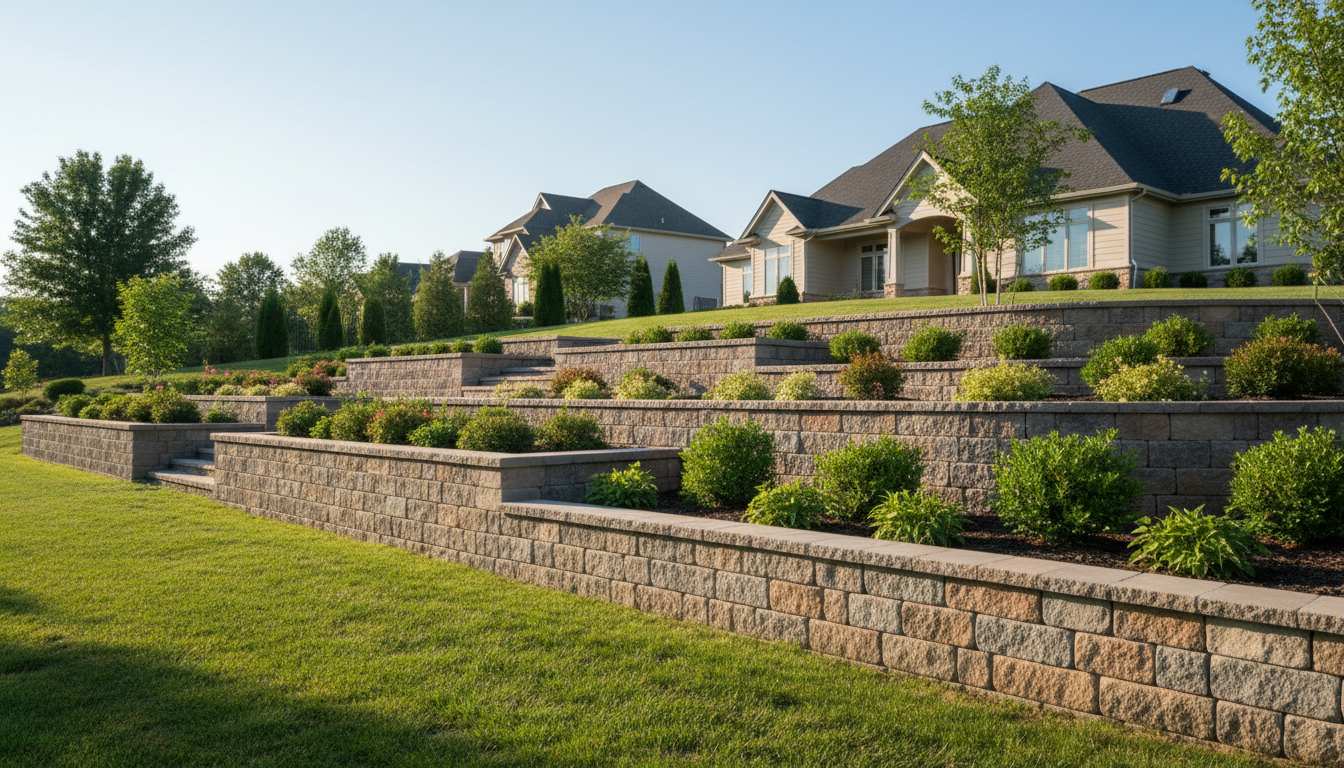
The average retaining wall cost Las Vegas typically ranges from $15 to $40 per square foot, with total project prices often falling between $3,225 and $11,000. These rates vary based on materials like poured concrete or decorative block, while site accessibility and wall height also influence the final estimate. Proper budgeting for desert drainage requirements is essential to ensure the long-term stability of the structure.
Building a retaining wall in the Las Vegas valley is rarely just about aesthetics; it is a battle against caliche soil and extreme drainage shifts. Homeowners often find themselves caught between rising material prices and the strict structural demands of Clark County building codes. At Harris Daboy Big City Builders, we understand that a wall failure is a liability you cannot afford. This guide breaks down the financial landscape of 2026, comparing concrete and block material costs while addressing the hidden expenses of desert drainage. You will learn the exact permit triggers for the three to four foot rule, the costs associated with repairing leaning structures, and how to navigate the complexities of shared wall liability in Nevada. Whether you are budgeting for a hundred foot project or fixing a crack, our expert analysis ensures your investment stands firm against the desert elements.
Las Vegas Retaining Wall Costs: 2026 Price Projections
Predicting the retaining wall cost Las Vegas homeowners will face in 2026 requires an understanding of both material trends and our specific geological challenges. Currently, project estimates typically fall between $15 and $45 per square foot. This range accounts for the shift from basic gravity walls to complex, engineered structures. As a provider of comprehensive residential and commercial services, we have seen how national averages often fail to reflect the reality of building in the Mojave Desert.
One of the most significant factors in our region is caliche soil. This layer of hardened calcium carbonate acts like natural concrete, often requiring heavy machinery or hydraulic breakers just to dig a standard footing. Excavation in North Las Vegas or Summerlin can take significantly longer than a similar project in a region with softer topsoil, directly increasing the initial site preparation costs.
It is also essential to differentiate between a simple garden wall and a structural retaining wall. A garden wall under two feet primarily serves an aesthetic purpose and requires minimal reinforcement. In contrast, a structural wall must withstand the lateral pressure of the earth it holds back, requiring deeper footings and often professional engineering.
Local prices are also shaped by Clark County labor rates and the logistics of transporting heavy masonry units across the desert. By 2026, we anticipate that fuel costs and the demand for specialized masonry will keep these rates at the higher end of the spectrum. Understanding these local variables ensures a realistic budget for any property improvement.
Comparing Block Wall and Concrete Material Costs
Once the site is cleared, the choice of material becomes the primary driver of your retaining wall cost Las Vegas project. In Southern Nevada, the Concrete Masonry Unit (CMU), or cinder block, is the industry standard due to its availability and structural reliability. Standard CMU walls typically range from $15 to $30 per square foot. While these provide a functional, clean look, many homeowners opt for split face blocks. These units feature a rough, stone-like texture that increases material costs but significantly enhances curb appeal for residential front yards or visible landscape features.
Poured concrete walls represent a more significant investment, often pricing between $37 and $45 per square foot. This method offers superior longevity and a sleek, modern aesthetic, but it requires extensive formwork and specialized labor. For a premium look, natural stone or decorative pavers are available, though these are often the most expensive options because of the intensive manual labor required for stacking and mortar work.
Material Type | Estimated Cost (per sq. ft.) | Best Use Case |
|---|---|---|
Standard CMU Block | $15 - $30 | Perimeter walls and utility terracing |
Split Face Block | $22 - $35 | Front yard landscaping and high-visibility areas |
Poured Concrete | $37 - $45 | Industrial structural support and modern design |
Natural Stone | $45 - $80+ | High-end custom residential builds |
A critical factor that many DIY estimates overlook is the 1/3 rule. To ensure a wall can resist the lateral pressure of shifting desert soil, experts generally require that one-third of the total block height remains below grade. If you need a visible four-foot wall, you are actually purchasing and installing six feet of material. This underground portion, which includes the footing and the buried courses, must be factored into your material count and total budget. Our team at Harris Daboy Big City Builders emphasizes this during the general contracting phase to prevent structural failure and ensure your project gallery finish remains perfect for years.
The Desert Drainage Factor: Why Your Wall Needs More Than Just Blocks
While the Mojave Desert is known for its arid climate, ignoring water management is the most common reason for structural failure in Southern Nevada. When monsoon season hits, the soil behind a wall becomes saturated quickly. This creates hydrostatic pressure, a force where the weight of the trapped water pushes against the masonry. Without proper outlets, this pressure can exceed the load-bearing capacity of the blocks, causing the wall to bow or collapse entirely.
A resilient retaining wall cost Las Vegas estimate must include a dedicated drainage system. For any wall over two feet high, the answer to the question "Do block retaining walls need drainage?" is a resounding yes. Our approach at Harris Daboy Big City Builders involves several critical layers designed for desert weather patterns:
Gravel Backfill: A 12-inch wide column of clean, angular stone placed directly behind the blocks allows water to sink quickly to the base rather than sitting against the wall.
Perforated Drain Pipes: Often called French drains, these pipes collect the sinking water at the footing level and channel it to a safe discharge area.
Weep Holes: Small PVC outlets installed every few feet along the bottom course of blocks to relieve immediate pressure.
Filter Fabric: This prevents fine desert silt from infiltrating and clogging the gravel drainage zone over time.
Integrating these features typically adds between $8 and $15 per linear foot to the total project price. While this may seem like an added expense during the general contracting phase, it is a fraction of the cost of the structural restoration required after a collapse. Investing in drainage ensures your project gallery remains a showcase of stability rather than a lesson in preventable repairs.
Block Wall Repair Cost: Fixing Cracks and Leaning Walls
Maintaining a property in the Valley often involves addressing structural fatigue, which adds to the long term retaining wall cost Las Vegas homeowners must manage. We frequently encounter stair-step cracks that follow mortar lines, a common symptom of minor soil settling or thermal expansion in the desert heat. Minor aesthetic patching for these fissures might only cost $500. However, a leaning wall is a much more severe issue. This usually stems from an undersized footing or the original builder ignoring the 1/3 burial rule. Stabilizing a leaning section with helical piers or grade beams can quickly rise to $3,000 or more.
Local industry data suggests that professional structural restoration for significantly damaged walls typically ranges from $3,225 to $4,200. This level of general contracting work involves excavating the backfill to relieve hydrostatic pressure, reinforcing the internal rebar, and potentially resetting several courses of masonry. Decisions on whether to repair or replace often come down to a simple calculation. If more than 30 percent of the structure shows signs of bowing or if the footing has fractured, a total tear down and rebuild is usually the more cost-effective path forward.
Investing in comprehensive residential and commercial services to diagnose the root cause prevents a cycle of recurring repair bills. You can view successful restoration projects in our project gallery to see how properly reinforced masonry stands up to the shifting desert landscape.
Permits and Engineering: The 3 to 4 Foot Rule in Clark County
Beyond the physical labor and materials, navigating local building codes is a critical component of your total budget. In the City of Las Vegas, North Las Vegas, and Henderson, the 3 to 4 foot rule dictates when a project transitions from simple landscaping to a regulated structural build. Generally, any wall that retains more than three feet of earth, or any wall supporting a surcharge like a nearby driveway or a steep slope, requires a formal building permit and a wet stamped set of plans from a licensed structural engineer.
These professional engineering fees typically add between $500 and $1,500 to the retaining wall cost Las Vegas homeowners must anticipate. While this increases the initial general contracting investment, it ensures the wall is mathematically designed to withstand local seismic activity and the specific lateral loads of your property.
Many homeowners ask, "Does a 2 foot retaining wall need a footing?" The answer is always yes. Even if the wall is short enough to bypass the formal permit process, it still requires a structural foundation. Without a properly excavated trench and a leveled base of compacted gravel or concrete, the wall will eventually settle unevenly. Skipping the footing is a primary cause of the leaning structures featured in our project gallery after they require a complete rebuild. Our comprehensive residential and commercial services handle these regulatory hurdles, ensuring every build meets Clark County Building Department standards for safety and longevity.
Who is Liable for a Shared Retaining Wall in Nevada?
Building a wall on a property line introduces legal layers that can significantly affect your total retaining wall cost Las Vegas budget. In many Southern Nevada residential zones, a wall situated precisely on the boundary is considered a shared asset, technically requiring joint maintenance from both parties. However, Nevada law and local precedents often prioritize the benefit principle. The neighbor whose property is at a higher elevation, and thus whose land is being physically supported by the structure, typically bears a higher degree of liability for its structural integrity. If that wall fails due to poor drainage or soil pressure, the uphill owner might be held responsible for damages caused to the downhill property.
Before starting any general contracting project, you must verify the exact location of the structure. Review your property survey to confirm if the wall is a party wall or sits entirely on one parcel. Furthermore, Las Vegas homeowners should scrutinize their HOA Covenants, Conditions, and Restrictions (CC&Rs), as these documents often supersede general guidelines and dictate specific cost-sharing ratios. Our team at Harris Daboy Big City Builders provides comprehensive residential and commercial services that include reviewing these site conditions to ensure your new build avoids future neighbor disputes and legal complications.
Estimating a 100 Foot Retaining Wall Project
To provide a clear benchmark for your budget, consider a standard backyard improvement project. A common question homeowners ask is, "How much does it cost to build a 100 foot retaining wall?" For a 100 foot long wall standing 4 feet high, several variables influence the final invoice. This specific height triggers the permit and engineering requirements discussed earlier, which we manage through our comprehensive residential and commercial services.
A typical breakdown for a 400 square foot project using standard CMU blocks often follows this structure:
Project Component | Estimated Cost Range | Details |
|---|---|---|
Excavation & Footing | $2,500 - $4,500 | Includes caliche removal and steel-reinforced concrete base |
Masonry & Labor | $4,000 - $7,000 | Block laying, mortar, and internal grouting |
Drainage System | $800 - $1,500 | Gravel backfill, perforated pipe, and weep holes |
Capping & Finish | $700 - $2,000 | Decorative cap stones or specialized split-face textures |
Total project estimates generally range from $8,000 to $15,000 or more, depending on site accessibility and material choice. As a general contracting specialist, Harris Daboy Big City Builders ensures these estimates cover the essential work, such as the buried courses required for stability. You can see examples of these completed 100 foot structures in our project gallery, where we demonstrate how high quality materials safeguard your investment against the unique pressures of the Las Vegas Valley.
Managing the costs and technical requirements of a retaining wall in the Las Vegas climate requires careful planning around drainage and soil stability. While understanding the 2026 landscape helps you prepare your budget, executing a project that lasts decades often requires specialized local knowledge. If you want expert help navigating these variables, feel free to browse our full range of construction services to find a solution that fits your property. We focus on building structures that thrive in the desert heat.


